Saturday, April 8, 2023

3 Best Entry Points: Forward Testing the Wealth Trading Strategy

Mastering the Art of Wealth Trading

Powerful Tools for Identifying Optimal Entry Points

We will conduct a forward performance test of Oliver Velez's Wealth Trading Strategy featured in his YouTube tutorial How to use the 50, 20, and 200 SMA All Together. Despite our limited understanding, testing the strategy is the only way to evaluate our trading plan. We may encounter losses, but we will also gain insights. As Oliver Velez said, "It is impossible to win until you become experienced and impossible to become experienced until after you have become the number one expert at losing."

  1. Monthly Candlestick Chart
  2. 20-Moving Average (simple, in blue color)
  3. 50-Moving Average (simple, yellow color)
  4. 200-Moving Average (simple, red color)


Forward performance testing

Forward testing is a method of evaluating a trading strategy or system using real-time or future data, rather than historical data. It involves applying the strategy to current market conditions and tracking its performance over time to see how well it performs in practice. This can help traders gain confidence in their strategy and identify any potential issues or areas for improvement before risking real money. Please refer to the article Backtesting and Forward Testing: The Importance of Correlation published by Investopedia.com for a more detailed discussion. 

Here are more details about our forward testing activity:

  • Method of analysis: Technical Analysis
  • Trading style: Swing Trading
  • Holding period: 3 hours to 3 months
  • Buying power: Php 15,000
  • Stock bias: Ayala Land, Inc.
  • Number of trades: 20
  • Max daily loss: Php 300

3 Best entry points for ALI

  • Buy color near the 20-Moving Average (simple)
  • Buy color between 20- and 50-Moving Average (simple)
  • Buy color near the 200-Moving Average (simple)

#1 Buy color near the 20-Moving Average (simple)

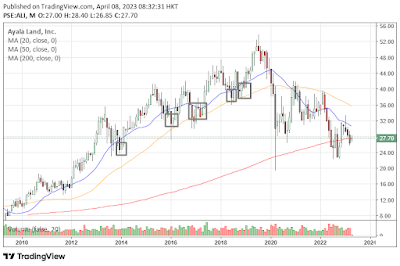
Based on the 20-MA performance, it would be wise to hold on to cash at the moment since ALI closed at Php 27.70, way below its 20-MA. Although we have identified the 5 best entry locations to buy ALI over the past 13 years, it is best to use the entry point when the 20-MA is rising. However, it is important to note that all these entry points occurred before the COVID-19 pandemic collapse.


Ayala Land, Inc. (ALI) 10-year monthly candlestick chart including the 20, 50 and 200 Simple Moving Average (SMA) and Volume Technical Indicators.


#2 Buy color between 20- and 50-Moving Average (simple)

Based on our analysis of ALI's 20-MA and 50-MA performance, it would be wise to hold on to cash for now. ALI hasn't seen much trading activity in the zone between the 20-MA and 50-MA this year, indicating that it may not be the best entry point at the moment. However, in the past 13 years, we have identified the 5 best entry locations to buy ALI, all of which occurred before the pandemic. It's worth noting that these entry points were found in the zone between the rising 20-MA and rising 50-MA, which is considered the optimal entry point for many traders. Nonetheless, given the current market conditions, we believe that holding on to cash is the best course of action.


Ayala Land, Inc. (ALI) 10-year monthly candlestick chart including the 20, 50 and 200 Simple Moving Average (SMA) and Volume Technical Indicators.


#3 Buy color near the 200-Moving Average (simple)

It appears that our decision to resume our online trading activities and use ALI to forward test some trading strategies for SMALLCOST may not be favorable at the moment, given our aim to promote stock market participation among traders with limited capital. However, we can still find hope in our Rule #3, which prioritizes the 200-MA.

Applying Rule #3 to assess the movement of ALI in relation to the 200-MA shows very a promising entry point in between Php 27.70 and Php 28.50 price zone. Are we going to win in this trade? Let's find out this week. But the more important question is what should be our stop-loss level. That is a question for risk-to-reward ratio to answer.


Ayala Land, Inc. (ALI) 12-month monthly candlestick chart including the 20, 50 and 200 Simple Moving Average (SMA) and Volume Technical Indicators.

Risk-to-Reward Ratio Calculation for ALI:

  • Entry point: Php 28
  • Target Exit:  Php 30
  • Stop-Loss level: Php 27
  • Risk-to-Reward Ratio: 1:2
  • Reward Protection: 75%
  • Minimum exit point: Php 29.50
  • Risk (Potential Loss): 28 - 27 = 1
  • Reward (Potential Profit): 30 - 28 = 2
  • Reward Protection: Php 2 * 75%
  • Protected Reward: Php 1.5
  • Minimum Exit Point: Php 29.50

Using the formula:

  • Risk-to-Reward Ratio = (Potential Loss) / (Potential Profit)
  • Risk-to-Reward Ratio = Php 1 / Php 2
  • Risk-to-Reward Ratio = 1:2

Here we have a risk-to-reward ratio of 1:2, which means the potential profit is twice the size of the potential loss.


Benchmarking: BPI Trade Trader's Takedown Dated March 30, 2023

We are sharing verbatim the BPI Trade Trader's Takedown dated March 30, 2023, for its Stock Feature: ALI as our benchmark:


"We maintain our BUY rating on ALI and keep our PT of Php40/shr (+38% potential upside), which is based on a 50% discount to NAV. While expectations of prolonged elevated interest rates present downside risks to ALI's residential business (~50% of FY22 sales), we think this is more than priced-in by the 18.8% YoY decline of the stock compared to the 7.2% drop in the PCOMP over the same period. ALI still trades at a wide discount to historical levels (~64% discount to NAV and FY23F P/E of 18.3x vs. 5-year average PER of 32x) with current valuations ascribing zero value to its mall portfolio or a 45% discount to its land bank value, in our view. We believe that the valuation discount is unjustified, especially given ALI's: 1) position as the 2nd largest mall operator in the country, a clear beneficiary of the recovery in domestic consumption; and 2) vast land bank (~12k ha), the largest among the listed property firms."


What to expect

The Risk-to-Reward Ratio Calculation for ALI is a crucial step in determining the potential profit and loss in a trade. With an entry point of Php 28, a target exit of Php 30, and a stop-loss level of Php 27.00, the risk-to-reward ratio is 1:2, meaning the potential profit is twice the size of the potential loss. To further protect the potential profit, a reward protection of 75% is implemented, resulting in a protected reward of Php 1.5. The minimum exit point is Php 29.50. With this information, we can expect to make 20 trades within a 90-day period to test this trading strategy and aim for a minimum of 6% to 8% gain. It is important to note that while the risk-to-reward ratio is favorable, there is still a potential for losses, and proper risk management is crucial in any trading activity. 

Stay tuned for our updates as we aim to achieve a 60%-to-70%-win rate and master the art of wealth trading as well as become experts at losing responsibly.

SMALLCOST Blog is Back: 13-Year Pause Ends as Its Online Trading Restarts

Welcome Back to SMALLCOST: Our Journey to Restarting Online Trading


3 Important Lessons Learned from Our Previous Trading Experience


1. The Importance of Learning from Past Trading Experiences

Learning from past trading experiences is essential to improve one's trading skills and making better decisions in the future. By analyzing past trades, traders can identify patterns and tendencies in their behavior that might be hindering their success. They can also identify successful strategies that worked well in the past and apply them to future trades. Additionally, examining past trades can help traders identify their strengths and weaknesses and develop a plan to capitalize on their strengths while mitigating their weaknesses. Learning from past trading experiences is an ongoing process that requires reflection, analysis, and adaptation.


2. The Role of Luck in Trading

Luck in trading is often misunderstood as a random occurrence that cannot be controlled. However, the truth is that luck plays a crucial role in trading, but it is not entirely random. Rather, it is a byproduct of the consistent implementat

ion of a well-planned trading strategy. Luck comes from cultivating good trading habits and continuous learning to improve your trading decisions.

Successful traders understand that luck is not a stand-alone factor in trading. Instead, it is the result of discipline, analysis, and a willingness to learn from past mistakes. By sticking to a proven trading plan and avoiding impulsive decisions, traders increase their chances of success and reduce the impact of bad luck.

While luck can play a role in short-term trading results, it is long-term consistency that counts. By staying true to a trading strategy, traders can achieve consistent results and avoid being distracted by short-term fluctuations. Luck may help you catch a few good trades, but a well-crafted trading plan is what will sustain your trading career in the long run.
Our current 6% return on investment in online stock trading can be attributed purely to luck, as it is a case of a rising tide lifting all boats.


3. The Importance of Continued Learning

Continued learning is crucial in the field of online stock trading, as it enables traders to stay informed about market trends and developments. Without ongoing education, traders risk being left behind by new technology and strategies and may miss out on potential profits. Therefore, it is essential for traders to make learning a habit, and to stay up-to-date with the latest market news, trading techniques, and other relevant information. By doing so, traders can enhance their decision-making skills and make informed investment decisions that can ultimately lead to greater success in online stock trading.

Here are the 5 most valuable lessons that SMALLCOST has learned from a decade of experience:

  • Luck can play a role in trading, but it is not a sustainable or reliable strategy. Traders must develop consistent and informed trading strategies to succeed in the long run.
  • Saving and increasing trading capital is crucial for small traders to compete in online stock trading. This requires discipline and sacrifice, such as cutting unnecessary expenses and generating extra income.
  • Continuous learning is essential for traders to stay informed about market trends, new technologies, and strategies.
  • Consistent implementation of a trading strategy is critical for success in online stock trading. Traders must stick to their plans and not be swayed by emotions or external factors.
  • Tracking and analyzing trading performance is crucial for traders to learn from their successes and failures, and to improve their strategies over time.

Restarting Our Online Trading Activities

Restarting our online trading activities can be an exciting and nerve-wracking experience. It is essential to take the time to review and update our trading strategies to ensure they are effective in the current market environment. Additionally, we should carefully evaluate our risk tolerance and set appropriate stop-loss levels to protect against significant losses. Adequate preparation and research can help traders navigate the market and increase their chances of success. It is important to approach trading with a level-headed and disciplined mindset, focusing on long-term success rather than short-term gains. By continuously learning and adapting to market conditions, traders can maximize their potential for profitability and achieve their trading goals.


Preparing to Restart: 5 Steps We Took

Here are 5 important steps that SMALLCOST took in preparing to restart our online trading activities:

  • Conducted a thorough review: We reviewed our past trading activities and identified areas that needed improvement. We analyzed our past trades, assessed our risk management strategies, and studied market trends.
  • Updated our knowledge: We recognized that the market is always changing and that it was important to keep up with new trends and technologies. We watched online tutorials, read books and articles, and more to update our knowledge.
  • Set new goals: We established new trading goals that were specific, measurable, achievable, relevant, and time-bound (SMART). We made sure that our goals were aligned with our risk tolerance and our available trading capital.
  • Developed a trading plan: We created a trading plan that outlined our entry and exit strategies, risk management rules, and other trading guidelines. We tested our plan using historical data and we will be making more adjustments as necessary as we continue forward testing our ideas.
  • Increased our trading capital: We saved more money and reduced our unnecessary expenses to increase our trading capital. We transferred the funds to our trading account and made sure that we had enough margin to trade comfortably. This time around, we are planning to work with a small budget of Php10,000 to Php20,000. The funds will come from a combination of fresh capital and stocks that we still hold after liquidating some positions in the past.


By taking these steps, SMALLCOST was able to prepare hopefully effectively for our online trading activities, and we look forward to sharing our results with our readers in the future.


Changes and Improvements to Our Approach

 The top 3 changes and improvements to our approach would include the following:

  • Increased emphasis on continuous learning: We recognized the importance of staying up-to-date with the latest trends, news, and strategies in trading. As a result, we plan to dedicate more time to learning and research to improve our trading skills and decision-making.
  • Strategic approach to trading: We learned from our past experiences that trading based solely on luck is not a sustainable approach. To increase our chances of success, we will implement a more strategic approach to our trades, guided by a well-defined trading plan.
  • Better financial management: We recognized the importance of having sufficient trading capital and being able to manage our finances better. To achieve this, we plan to save more, reduce unnecessary expenses, and generate additional income streams to increase our trading capital.

Our Performance Targets

Oliver Velez, a renowned stock trader and author, emphasizes that the performance targets of a starter stock trader should focus on consistency rather than profits. 


Win Rate

According to Oliver Velez, a beginner trader's primary goal should be to achieve a 60-70% win rate and a risk-to-reward ratio of 1:2. To us, this means that for every peso we risk, we should aim to earn two pesos in profit. By achieving this level of consistency in our trades, even beginner traders can build a strong foundation and gradually increase their profits over time.


Risk-To-Reward Ratio

The risk-to-reward ratio of 1:2 means that for every unit of risk taken, the trader aims to gain two units of reward. For example, if a trader risks Php 1,000 on a trade, their target reward should be at least Php 2,000. This ratio is used to help traders ensure that their potential gains outweigh their potential losses and to maintain a positive expectancy in their trading strategy over the long run. By using a risk-to-reward ratio of 1:2 or better, traders can potentially be profitable even if they have a winning percentage of less than 50%.

Here's the formula and an example computation for the risk-reward ratio we are using:

Formula:

Risk-to-Reward Ratio = (Potential Loss) / (Potential Profit) 

Example:

Let's say we are buying a stock at Php28 and we set our stop-loss at Php27.00. We also set a reward target of Php30. The potential profit is Php2 (Php 30 - Php 28), while the potential loss is Php 1 (Php28 - Php27).

Using the formula:

Risk-to-Reward Ratio = (Potential Loss) / (Potential Profit)

Risk-to-Reward Ratio = Php 1 / Php 2

Risk-to-Reward Ratio = 1:2

In this example, we have a risk-to-reward ratio of 1:2, which means the potential profit is twice the size of the potential loss.

More Online Trading Performance Measures

We are also setting other performance measures for our online trading activities, including:

  • Investor Type: Aggressive Investor

  • Trading Style: Swing Trader

  • Holding Period: hours to days

  • Stock Bias: Ayala Land, Inc. (ALI)

  • Buying Power: Php 10,000 to Php 25,000

  • Minimum Cumulative Profit: Php1,500.00

  • Minimum Number of Trades: 200
  • Minimum Time: 90 days

  • Maximum Share Exposure: 500

For example, let's say we have a total trading capital of Php 25,000 and we want to invest in Ayala Land, Inc. (ALI). Let's imagine, the current market price of the stock is Php 25 per share. At this price, ALI trades at a board lot of 100 shares and a tick size of Php 0.05. 

If we have a maximum share exposure of 500, then we can only buy up to Php 12,500 worth of ALI stock equivalent to a net amount of Php12,536.88 including transaction cost.

To compute for the maximum number of shares we can buy, we can multiply the maximum share exposure of 500 shares by the current market price of Php 25 per share, which gives us Php 12,500 exposure.

Therefore, our maximum share exposure of 500 shares for ALI is around 50% of our total trading capital or buying power.

  • Daily Loss: Php 200
  • Continuing the above example, if we bought 500 shares of ALI at Php 25 per share for a total of Php12,536.88 including transaction cost, we should sell at a stop-loss of Php 24.90 to limit our daily loss to Php 200.


    Tracking Our Progress: Recent Performance Results

    In tracking our investments, we would use the method described in the related post Measuring Our Stock Trading Profit by The Starter Investor Blog. In summary:

    Trading Profit = Previous Selling Level - New Buying Level


    Analysis of Performance Results

    In analyzing the performance results of our stock trading activities, we need to look beyond the profits or losses we have incurred. 

    • It is important to examine our trading behavior, risk management, and decision-making processes. By keeping track of our trades and maintaining a trading journal, we can identify patterns and tendencies that may have contributed to our results. 
    • We also need to evaluate the effectiveness of our trading strategy and make necessary adjustments to improve our performance. 
    • Furthermore, it is crucial to maintain discipline and manage our emotions to avoid making impulsive and irrational decisions. By conducting a thorough analysis of our performance results, we can gain valuable insights and continuously improve our trading skills.


    The Journey and the Road Ahead

    Over the years, SMALLCOST has experienced the ups and downs of the stock market. From our early days of trading with a small capital, we have learned the importance of proper risk management, discipline, and continuous learning. 


    Reflecting on Our Journey So Far

    Reflecting on our journey so far, we have come a long way in terms of our understanding of the stock market and our trading performance. We have learned the importance of continuous learning, risk management, and discipline in our approach. Our journey has also highlighted the role of luck in trading and the importance of learning from past experiences. We have identified changes and improvements to our approach and set performance targets to guide our trading activities. Moving forward, we remain committed to our trading goals and confident in our ability to navigate the challenges ahead.


    The Road Ahead: Join Us on Our Journey

    Looking ahead, we are excited to continue our journey in the stock market. We know that there will be challenges and risks along the way, but we are committed to applying the lessons we have learned and improving our trading strategies. We will also continue to share our experiences and insights through our blog, hoping to inspire and help others who are also on their journey to financial freedom. So join us, as we navigate the ups and downs of the stock market and work towards achieving our goals.

    Friday, April 7, 2023

    Connecting with AyalaLand's Vision: Our First Stockholders Meeting Experience

    A Small Capital Stockholder's Insight into Ayala Land's Operations

    As a small capital stockholder, attending our first AyalaLand stockholders meeting was a delightful experience. The event was held at InterContinental Manila on April 14, 2010. 


    AyalaLand Annual Stockholders' Meeting Venue


    AyalaLand Annual Stockholders' Meeting Venue

    AyalaLand Annual Stockholders' Meeting Room


    Annual stockholders' meeting tokens

    Upon registration, we received a tag, a copy of the 2009 annual report, a meal stub, and a meal box for the event. We were thrilled to be personally present with the majority stockholders of the company. 


    AyalaLand Annual Stockholders Meeting Tag


    The Notice of Meeting with the Annual Report CD


    The Meal Stub


    The Meal Box


    The Meal


    The USB Stick


    Insight into the company's future plans and current projects

    It was a rare opportunity to get an insight into the company's future plans and current projects. The meeting's agenda included a review of the previous year's performance and the election of new directors.


      AyalaLand Annual Report 2009

    AyalaLand Annual Report 2009

    During the meeting, we learned about Ayala Land's various residential and commercial projects, including the expansion of Ayala Center in Cebu and development of Vermosa in Cavite. We also heard about the company's commitment to sustainable development and its initiatives to reduce its carbon footprint. 


    Engagement and discussion among the stockholders

    It was fascinating to witness the level of engagement and discussion among the stockholders. The meeting was an excellent opportunity for us being a small capital stockholder to feel connected to the company's operations and decision-making processes. 


    AyalaLand Board of Directors and Officers


    Unforgettable experience

    Attending the AyalaLand stockholders' meeting was truly an unforgettable experience. It provided an opportunity to gain insight into the company's vision and future plans. Looking back, it's a pleasure to reminisce about our experience 13 years and 1 month later. With an investment of under Php10,000, we were able to meet exceptional individuals and hear brilliant ideas. Overall, it was an invaluable experience.

    Sunday, June 6, 2010

    Year-to-Date Performance as of May 2010

    THIS IS OUR FIRST PERFORMANCE REPORT about what smallCOST had accomplished for the first five months of this year 2010.

    Stock trading activity
    smallCOST started the year 2010 on Week 1 ending January 2, with 5,000 pesos equity in our BPI Trade online stock trading account. Our stock trading activity began on Week 6 ending February 6 when we bought 100 shares of AyalaLand (PSE symbol: ALI) at 10.50 per share. We closed this position on Week 10 ending March 6 when we decided to sell ALI at 11.50 per share. We had a net profit of 49 pesos equal to a 1% return on our trading equity.

    Equity build-up
    By Week 22 ending May 29, we made two deposits to our BPI Trade trading account. First, on Week 21 ending May 22 with an amount of 15,000 pesos, and then on the following Week 22 ending May 29 with 5,000 pesos. Hence, by the end of May 2010, we had a total trading equity of 25,296 pesos including our net income from stock trading.

    Buy and sell transactions
    As of May 31, 2010, we completed a total of 5 buy orders and 2 sell orders. In the process, we had accumulated a net profit of 296 pesos representing 1.2% return on total assets. Our stock portfolio consisted of a single stock: ALI.

    Return on equity
    For computation of our return on equity on a weekly basis, we computed our average weekly equity and compared this against our year-to-date net income. This reckoning is not standard. This is our own devise and formulated for our own purposes. On this basis, we managed a 4% return on average weekly equity as of the month ending in May 31, 2010.

    Balance sheet
    Our balance sheet contains only 3 main accounts: Cash, Stocks and Equity. As of May 31, 2010, we have a cash balance of 2,026 pesos and our stock position valued at 23,270 based on purchase cost. Altogether, these two asset accounts total 25,296 pesos. Our total equity is equal to our total assets at this point.

    Stock trading cycle
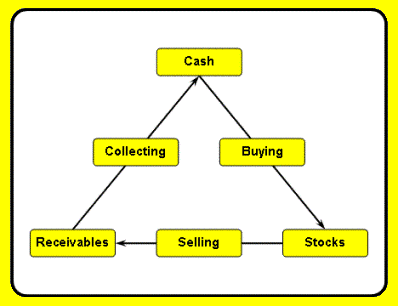
    This is how our online stock trading activity looks like:

    Stock Trading Cycle used by SMALLCOST
    We start with our cash to buy stocks at the Philippine Stock Exchange (PSE) through our online broker BPI Trade. At the completion of our buy order, an inventory of stocks which we can call a portfolio is then created. When our decision criteria is satisfied, we can then decide to sell any or all of our stock position using the same online broker, thereby generating receivables during the 3-day clearing period. After clearing, we collect our sales proceeds in the form of cash deposited to our trading account.

    Next Post: Week 23 Ending June 5, 2010 Stock Trading Update

    Saturday, May 29, 2010

    Trading China Banking Corporation (CHIB)

    CHINABANK (CHIB) became an attractive buy for smallCOST since the company's Board of Directors declared a 10% stock dividend on top of the 12 pesos per share cash dividend at its 5th of May 2010 meeting.

    To take advantage of the opportunity, smallCOST increased his stock trading equity by 5,000 pesos and bought 10 shares of CHIB at 437.50 pesos per share for a total cost of 4,398 pesos this week. Record and payment dates are to be announced.

    Outlook for Week 23: smallCOST is looking for buy positions next week. If Ayala Land Inc. (ALI) falls below 13 pesos per share, we will buy more of this stock.

    Sunday, May 23, 2010

    Stock Trading Game for Small Players

    ONLINE STOCK TRADING could be a costly proposition for small players like us. Every time you make a trade, your broker's commission is a sure thing as other fees and charges that come with it, including Internet Cafe expenses. Yet even with the disadvantage we still love to play this game of money.

    Our solution to this predicament is to increase our equity the quickest way we can. What we did is to save more, let go of all unnecessary expenses and transfer the funds to our BPI Trade account. Less eating out, less buying of newspapers, walking to save on bus fare, avoiding credit card use, and generating extra income by doing overtime work. These sorts of things are just to accumulate more trading capital.

    Our efforts were positively rewarded when in Week 21, we were able to put 15,000 pesos more in our stock trading equity. We now have a total of 20,296 pesos in the capital including 296 pesos from our net stock trading gain. We sold our 100 shares of Ayala Land Inc. (ALI) on Week 16 when we booked a net profit of 247 pesos which we added to our Week 10 gain of 47 pesos.

    This Week 21, we also made two buys. We bought 1,200 shares of ALI when it hit 13.50 pesos per share or 50 centavos lower than our previous selling price. We ordered 200 shares more when the price went down further at 13 pesos per share.

    Outlook for Week 22: If the trend continues and ALI share price falls further, SMALLCOST will add more equity and buy some more of this stock.

    Thursday, March 11, 2010

    Trading The Ayala Land Stock

    AYALA LAND INCORPORATED (ALI) is on a roll enjoying active trading this week at the Philippine Stock Exchange. SmallCOST took advantage of this and made a trade ourselves. Details of the transactions can be found in the Weekly Stock Trading Journal section.

    Emotional trading
    Examining the emotions involved in our decision to trade at this time, we have to admit it is largely motivated by the urge to play the stock market rather than the more logical goal of earning a decent profit. We would strive to veer away from this tendency the sooner the better.

    Yet knowing the allure of placing the order, whether to buy or to sell, and the excitement of learning the immediate result of the trade relative to the closing prices, we know it is a difficult habit to break.

    Ayala Land
    On the 10th week of the current year, we closed our outstanding position of 100 shares of ALI which we recently bought the week ending February 06. In the process, we had a net gain of 49 pesos.

    Trading at the marginal level of one board lot, we have no alternative but to split our gross profit with our online broker BPI Trade every time we trade. The solution therefore is to achieve the minimum value of 10,000 pesos for every transaction to spread the cost.

    Our tendency to trade without much consideration to profit led us to purchase 100 shares of ALI this week at 11 pesos a share. A good volume of shares changed hands at this price in the past few days, so we thought we could do the same and grab our portion.

    Anchor position
    We are thinking of considering this board lot of 100 shares to be our anchor position. This means we would perish the thought of ever selling this position whatever happens to the market price of ALI. Let us see if we could hold on to this state of mind for as long as we can. (smallCOST could not and sold the stock on Week 16).

    Stock trading game
    The rest of our capital, we would use for position trading. We have a starting capital of 5,000 pesos. This means we still have nearly 4,000 pesos to play around with and place our bet on whatever stock we think would give us the best return, blue chips or no blue chips.

    Sunday, March 7, 2010

    Weekly Trading Tracker 2010

    Online Trading Lessons Learned: An Analysis of Our Performance Tracker


    Weekly Updates 2010

    SMALL CAPITAL ONLINE STOCK TRADING's activity will be monitored through this post and updated weekly. (For updates to this post see SMALLCOST Weekly Trade Tracker 2010)

    Dito natin malalaman kung paanong ang halagang limang libong pisong (5,000 pesos) capital ay mapalalago gamit and stock trading sa Philippine Stock Exchange.

    WeekEnding
    Sell
    Buy
    Profit/ (Loss)
    Total Equity
    %Gain/ (%Loss)

    Opening Balance


    5,000


    1
    Jan 02

    -

    -

    -

    5,000

    -
    2
    Jan 09

    -

    -

    -

    5,000
    -
    3
    Jan 16

    -

    -

    -

    5,000
    -
    4
    Jan 23

    -

    -

    -

    5,000
    -
    5
    Jan 30

    -

    -

    -

    5,000
    -
    6
    Feb 06

    -

    (1,073)

    -

    5,000
    -
    7
    Feb 13

    -

    -

    -

    5,000
    -
    8
    Feb 20

    -

    -

    -

    5,000
    -
    9
    Feb 27

    -

    -

    -

    5,000
    -
    10
    Mar 06

    1,122

    -

    49

    5,049

    1%
    11
    Mar 13

    -

    (1,123)

    -

    5,049

    1%
    12
    Mar 20

    -

    -

    -

    5,049
    1%
    13
    Mar 27

    -

    -

    -

    5,049
    1%
    14
    Apr 03

    -

    -

    -

    5,049
    1%
    15
    Apr 10

    -

    -

    -

    5,049
    1%
    16
    Apr 17

    1,370

    -

    247

    5,296
    6%

    This is our last update as of April 17, 2010


    Turning a Profit and Moving Forward

    Updated April 7, 2023


    As we close the books on our Weekly Trading Tracker for the year 2010 at Week 16, we are pleased to announce that we have ended with a profit of Php296.00 after 4 trades, resulting in an overall gain of 6%. While we are pleased with this outcome, we would like to be candid with our readers: we are not guided by any formal trading strategy, and we acknowledge that our knowledge and understanding of the market was not as extensive 13 years ago as it is now.


    Beyond Luck: Valuable Lessons Learned from Our Trading Journey

    That being said, we have learned an important lesson from our experiences in the market. We have discovered that, outside of a well-established trading system, luck can be the determining factor between a large profit and a deep loss. While some may argue that trading is simply a matter of luck, we believe that it takes a combination of both luck and skill to succeed in the market.


    Empowering Yourself: The Importance of Continued Learning in Trading

    For those who are new to trading, we encourage you to take the time to learn as much as you can about the market before investing your hard-earned money. Whether you choose to follow a well-established trading system or develop your own, it is important to have a clear understanding of the risks involved and to be prepared to make informed decisions.


    Closing the Books on a Successful Chapter

    As we look ahead to the future, we are excited to continue sharing our trading experiences with our readers. We hope that our Weekly Trading Tracker has provided some insights into the world of trading and has encouraged you to learn more about this exciting and ever-evolving field. Thank you for joining us on this journey, and we look forward to sharing more with you in the years to come.


    Coming Soon: SMALLCOST's Return to Online Trading - Stay Tuned!

    We invite all of our readers to stay tuned for our upcoming posts, as we announce the restarting of our online trading activities at SMALLCOST. We are excited to share with you our journey back into the world of trading and to provide you with a firsthand look at our experiences and results.

    As we embark on this new chapter, we remain committed to providing valuable insights and lessons that we have learned along the way. We hope that our experiences will inspire and inform you as you navigate the world of trading and investing.

    Thank you for your continued support, and we look forward to sharing more with you in the near future.